


Basil Gage Catterns
Early English Catterns White Banknotes
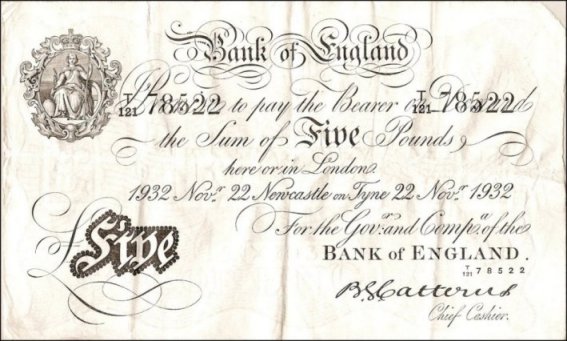
CATTERNS Five pounds banknote of 1932, issued in NEWCASTLE ON TYNE B228g. The top right corner is absent, confirming this is £5 watermarked paper. The paper was hand made in a wooden trays, one sheet at a time. One sheet being enough to cut into two banknote size pieces. Three edges are deckled, one is straight.
NOTCHES
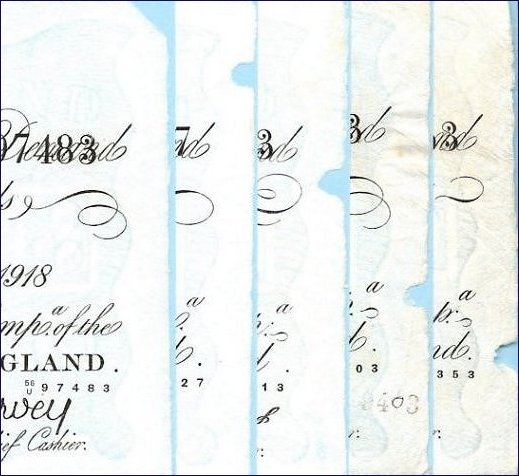
The right hand side of the banknotes shown above in order of denomination: £5 (at top), £10, £20, £50, £100. The notches appear on the right hand side only, which is always deckled. For further reading:- Promises to Pay page 98 or EPM page 411 10th Ed.
In order to prevent banknotes being printed on the wrong watermarked paper, Portals created a simple solution. As the sheet of paper was moulded, a small notch was formed on the right hand side, at a specific point for each denomination. This ensured the banknotes were printed on the correct watermarked paper. The paper was made up to create a pair of banknotes, thus, the left hand banknote has a straight right hand edge and three deckled edges, top, bottom and left. The right hand banknote has a straight left hand edge and three deckled edges, top, bottom and right - the right hand banknote with the relevant notch for the denomination. When a stack of watermarked paper is created the notch can be seen to be running up the stack.
This method is also utilised on the £200, £500 and £1000 banknotes. The £200 notch is between the £20 and £50 notch. The £500 notch is between the £10 and £20 notch. The £1000 notch is between the £5 and £10 notch.